Revisited – This is a re-posting of two recipes from my old blog, Café of the East.
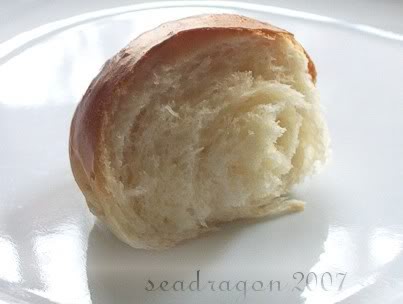
The soft and fluffy texture of the water-roux bun.
In 2004, a Chinese cookbook called ‘65°C湯種麵包’ was published and it soon became very popular with the Chinese bloggers. The book introduced to the Chinese baking community a new way of making soft breads and filled buns using a 65°C water-roux paste. Since then, all sorts of recipes using this method have been popping up all over the Chinese websites.
The innovation of this technique of making bread is the inclusion of a ‘water-roux (湯種 Tang Zhong)’, that is cooking portion of the flour and water first (as opposed to cooking flour and butter for a proper roux in the traditional sense) before adding it to the rest of the ingredients. The water-roux is supposed to allow the dough to absorb more liquid due to the gelatinization of the starch in the flour, thereby allowing the finished buns to have a fine soft texture and not get stale as quickly.
Any Asian-style buns made with the more traditional Sweet Bun Dough can be made using this water-roux method, thereby cutting out the need to add any artificial bread softener or improver.
The following is the basic recipe using the 65°C water-roux paste for sweet bun dough (湯種甜麵糰) to go with sweet filling. At the end of the recipe, I have also included another variation for savoury roll dough (湯種調理麵糰) to go with savoury filling, the method of preparation is the same.

Pork Floss Buns and Coconut Cream Buns made with water-roux sweet bun dough.
Japanese-Style Sweet Bun Dough 湯種甜麵糰
Makes 16 buns
[Ingredients]
375g bread flour
100g plain flour
35g milk powder
75g caster sugar
3/4 teaspoon salt
1 sachet (7g or 2 1/2 tsp) instant dry yeast
1 egg, lightly beaten
150ml (approx.) lukewarm water, adjust as necessary
40g butter, cubed
Water-Roux Paste (湯種) *:
25g (just under 2 tbsp) bread flour
125ml (1/2 cup) water
* Water-Roux is basically 1 part bread flour to 5 parts water.
https://cornercafe.wordpress.com/
[Preparation]
Water-Roux (湯種):
Mix flour and water in a small saucepan. Cook over low to medium heat, stirring continuously until it reaches 65ºC. It should have thickened to a paste at this stage, that is when you stir you can see the bottom of the pan. Remove from heat, place a cling film over the paste and leave until lukewarm, or room temperature, before using. (Alternatively if you don’t have a thermometer, cook as before until it starts to thicken, then continue to cook for about 1 more minute before removing from heat.) This water roux can be kept in an airtight container after cooling in the refrigerator for 1 day if not used immediately. However DO NOT USE if it turns grey in colour, that means it has gone bad.
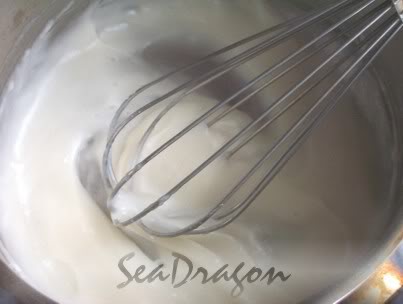
Water-roux paste.
For the Bun Dough:
1. Sift bread flour, plain flour, milk powder, caster sugar and salt onto the working surface. Add instant dry yeast and mix well. Form the flour mixture into a well. Add lightly beaten egg and lukewarm water roux and mix in. Gradually add just enough lukewarm water to form into a slightly sticky, soft dough. Knead for 10 minutes until smooth and elastic. During hand kneading, the dough also needs to be thrown onto the working surface once every few minutes between kneading to improve the dough structure. (I usually just pick up the dough to about head-high and throw it down onto the working surface 10 to 20 times every few minutes between kneading.)
2. Knead in butter until incorporated. (In many cookbooks, they mentioned that the dough at this stage should be able to be pulled and stretched into membrane, but it’s hard to achieve with hand kneading. I usually stop kneading when the dough sticks to the work surface and stretches like chewing gum when pulled!) Form the dough into a round ball and let it rise until double in size in a large greased bowl, cover with cling film (should take about 1 hour in warm weather, longer in winter months). Optimum room temperature for this first prove is 28°C with a humidity of 75%. To test if the dough has risen properly, dip a finger into bread or plain flour and poke down into the centre of the dough as far as your finger will go and pull out again – the hole should remain if it is ready. If the dough springs back, then it is not ready, continue to prove further.
3. Punch down, knead briefly and form into a ball shape. Then divide into 16 equal portions. The easiest way is to first divide equally into 4 larger portions first, then divide each of these again into quarters each. Form each into balls and let rest for 10 minutes.
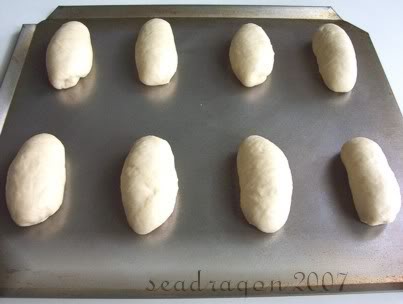
Plain water-roux buns before final proving..
4. Shape and fill the buns according to recipe. Place all finished buns on a greased baking sheet, lightly cover with cling film, and let rise until double in size (about 1 hour in warm weather, longer in winter months). Optimum room temperature for this final prove is 38°C with a humidity of 85%.
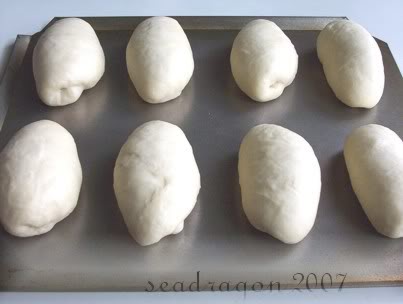
Plain water-roux buns after final proving (double in size).
5. Bake in preheated 190°C oven for about 12 to 15 minutes, or until golden brown.

Plain water-roux buns after baking.
[Variations]
This is a variation of the above recipe for use with savoury filling, the preparation is the same as above:

Savoury buns such as Hotdog Buns and Ham Buns made with water-roux bun dough.
Japanese-Style Savoury Roll Dough 湯種調理麵糰
Makes 16 buns
[Ingredients]
325g bread flour
150g plain flour
20g milk powder
50g caster sugar
1 teaspoon salt
1 sachet (7g or 2 1/2 tsp) instant dry yeast
2 eggs, lightly beaten
100ml (approx.) lukewarm water, adjust as necessary
75g butter, cubed
Water-Roux Paste (湯種) *:
25g (just under 2 tbsp) bread flour
125ml (1/2 cup) water

The texture of the Pai Pau made with water-roux bun dough.
Taste: Soft, fluffy and light
Consume: Equally good served warm or at room temperature
Storage: Can be kept for up to a week in airtight container in the refrigerator, re-heat in the oven or microwave before serving
Recipe Reference: ‘基本65°C湯種甜麵糰’ and ‘基本65°C湯種調理麵糰’ recipes from the cookbook ’65°C湯種麵包’ by 陳郁芬
 Corner Café
Hi, 汤种 bread is our favourite, I just baked 2 loaves of Hokkaido milk loaf, studded with cranberries, an hour ago. The taste is indeed so soft & fluffy !
Comment by lorrine — September 1, 2008 @ 4:49 pm |
I love this recipe…had been using it to make all kinds of buns for my DS school lunches….so versatile….substituted WWF or rye flour partially sometimes.
Comment by asan — September 27, 2008 @ 2:18 am |
I have tried this recipe several times but failed to obtain the desired results. I think it should be the way i cooked the water-roux paste without a thermometer. Will get a cooking thermometer and try again.
Comment by 3princesses — October 16, 2008 @ 4:07 am |
3princesses,
The kneading process and the proofing process are very important too. If you have time, please read the comment section of the same post in my old blog, Cafe of the East, they could be useful to you.
Comment by SeaDragon — October 16, 2008 @ 6:16 am |
is there a volume conversion of the ingredients?
Comment by deb lee — November 5, 2008 @ 3:13 pm |
deb,
I’ve a conversion table for ingredients using 250ml-cup/20ml-tablespoon in my forum.
Comment by SeaDragon — November 5, 2008 @ 7:44 pm |
Hello… can I use regular milk instead of powder?
Comment by Judy — January 19, 2009 @ 6:32 pm |
Judy,
Just omit the milk powder, and use milk (you need to scald it first) instead of the lukewarm water.
Comment by SeaDragon — January 20, 2009 @ 8:25 am |
[…] Japanese-Style Sweet Bun Dough from Corner Café’s Blog […]
Pingback by Cocktail Buns (Chinese coconut buns) « Kaitlyn in the Kitchen — January 23, 2009 @ 4:06 pm |
Hi Sea Dragon,
Is there a chance you can post of picture of your package of your sweetened whipped cream? Did you whip the cream yourself? Will it be okay to leave the bun at room temperature for a day or two? Thanks.
Wendy
Comment by Wendy — January 25, 2009 @ 4:52 pm |
Wendy,
I seldom buy commercial whipped cream, I always whip it myself. The sweetened whipped cream post is here:
Yes, you can leave the buns at room temperature for a day or two in cool temperature but keep it under cover or better still in airtight container, but best to keep chilled in hot weather.
Comment by SeaDragon — January 25, 2009 @ 6:43 pm |
Thank you, SeaDragon, for the sweetened whipped cream recipe. I wonder how I can sweetened it. Now I know. Your coconut cream buns look beautiful. Wendy
Comment by Wendy — January 26, 2009 @ 5:36 pm |
Hi SeaDragon,
Seems like a lovely recipe. Can the dough for this be made in a breadmaker? Would love to try. Thank you.
Comment by Lilly — February 8, 2009 @ 7:21 am |
Lilly,
Yes, you can use bread maker to knead the dough.
Comment by SeaDragon — February 8, 2009 @ 1:19 pm |
Hi SeaGragon,
If I use bread make to knead the dough, is the order to put in the ingredients the same (since bread maker’s manufacturing instruction always requires that dry yeast can not be mixed with the liquid)?
Thanks,
Jennifer
Comment by Jennifer — November 21, 2010 @ 6:55 pm |
Yes, do it in the same order. If you use bread maker to knead, you can check readiness by the windowpan test, that is the dough should be able to be stretched into a thin membrane.
It really depends on what type of dried yeast you’re using, if you use active dried yeast, you need to add water to prove first. If you’re using instant dried yeast, then you just add straight with other ingredients without having to pre-prove first. One important thing to remember is do not let dried yeast come into contact with salt for too long, you must mix it immediately with liquid as the salt will start to kill the dried yeast if they are in contact in their dry state.
Comment by SeaDragon — November 22, 2010 @ 4:19 pm |
Thanks SeeDragon. I did tried to make one yesterday, and the buns came out kinda heavy. I guess i did not knead enough. I’ll try to make again using the bread machine, hopefully it’ll come out good. I’ll let you know once I’m succeed.
Thanks again,
Jennifer.
Comment by Jennifer — November 22, 2010 @ 4:28 pm |
I tried this recipe yesterday and it took me almost 3 hours for proving the dough.
Today I dissolved the yeast with 50ml warm water and wait for 10 mins to double the volume, then mixed the dough and followed the recipe. The result was the same but only took me 2 hours for the result.
I’ll try replacing water with milk tomorrow.
Comment by Pearl — February 16, 2009 @ 12:20 pm |
Pearl,
You did use instant yeast and not active dry yeast, right? In winter time, 3 hours is not that uncommon at room temperature, I usually put it into very low oven to proof during winter for a quicker result. However, the longer proving time usually turns out very flavourful buns 🙂
Comment by SeaDragon — February 19, 2009 @ 10:04 pm |
Hi! I love your blog – you’re so talented! I had to use granulated sugar instead of castor, since I didn’t have any on hand. Also, I had to use milk. I wish I could have done it your way. Thanks for sharing!
Comment by Zoua — March 6, 2009 @ 3:22 pm |
Zoua,
Thanks for the kind words.
Comment by SeaDragon — March 8, 2009 @ 10:40 am |
Hey! this recipe looks soooo good. anyway, can i use active dry yeast and let it turn foamy in the lukewarm water before adding it to the flour mixture? thanks so much in advance (:”
Comment by Cherie — March 7, 2009 @ 1:26 pm |
Cherie,
Yes, you can use active dry yeast, but you have to increase the amount to 10.5g and dissolve it in a little of the lukewarm water until bubbly, then proceed as per recipe.
BTW, the conversion for yeast is as follows:
Fresh Yeast : Active Dry Yeast : Instant Yeast = 3 : 1.5 : 1
Comment by SeaDragon — March 8, 2009 @ 10:45 am |
Hi, I was wondering what type of butter did you use? salted or unsalted?
Comment by Tiff — March 8, 2009 @ 10:17 am |
sorry another question…
I’m confused what to do with the water roux paste? When do I add it in?
Comment by Tiff — March 8, 2009 @ 10:22 am |
Tiff,
I always use salted butter (please refer to ‘About the Recipes’ page in the side bar).
Add the water roux after you form a well with the flour mixture in Step 1 – ‘Add lightly beaten egg and lukewarm water roux and mix in.’
Comment by SeaDragon — March 8, 2009 @ 10:57 am |
Hi SeaDragon
I’m a newbie at baking came across your fabulous blog a few weeks ago while looking for Ma Lai Koh recipes (I haven’t tried your ‘modern version’ yet).
Your Photos, info and instructions are brilliant and on my very first attempted today I successfully made Char Siu Bao and bor lor bao using your Japanese-Style Sweet Bun Dough. it took all day as the first proof took 2 hours and the second 3 hours (I live in not so sunny UK) however it was worth the wait! The bread has a really good texture light and soft.
I have registered to join HCC a few days ago but haven’t received a activation email/ pass word, I’ve checked my spam, nothing there. I would be grateful if you would look into this for me, or let me know what I need to do next, Thanks
Comment by caramac — March 16, 2009 @ 6:13 am |
caramac,
Glad to hear you’ve had success with your first attempt.
In regards to HCC, there is no activation email, you should be able to log in straight after you registered. If you still have problems logging in, let me know.
Comment by SeaDragon — March 16, 2009 @ 10:57 pm |
[…] breads and pastries that you just don’t find it anywhere else. That is, until I discovered this recipe for making that oh so familiar buttery, light and fluffy tasting bread. I’ve been using […]
Pingback by MMmmmm Bread « Life In Mexico — March 26, 2009 @ 1:44 am |
Hi! I love the coconut filled buns we get at a mall near us so i want to make these!
Would the end result still be good if used all purpose flour?
Comment by charlotte — April 28, 2009 @ 9:55 am |
Hi charlotte,
No, please don’t use only ap flour to make this buns, the texture will be totally different.
Comment by SeaDragon — April 29, 2009 @ 9:22 pm |
Hi seadragon,
i just want to know what kind of oven do u use?
does it have a blower inside the oven cause ur bread look evenly baked?
Nice blog!!
cheers
Comment by everine — April 30, 2009 @ 7:35 pm |
everine,
I have an ancient gas oven, so no fan/blower or anything fancy. As every oven has its own quirk, so get to know your oven and adjust your baking accordingly.
Comment by SeaDragon — May 2, 2009 @ 11:10 am |
hi seadragon,
just so happens I made water roux yesterday and bake a batch od taro stuffed buns .am not very happy with the outcome(didn’t use your recipe) I wanted to try your japanese sweet dough recipe since i have water roux left in my fridge.ca I ask how much 25G flour and 125ml water yeild? by the way, your posting on how to shape buns is great. very clear detailing. thanks!
diane
Comment by diane — May 7, 2009 @ 8:00 am |
That should give you roughly 150g of water roux or just a bit less.
Comment by SeaDragon — May 10, 2009 @ 6:49 pm |
seadragon, is all purpose flour the same as plain flour? can i substitute it and still get the same results? thx.
Comment by madimomi1@yahoo.com — May 16, 2009 @ 8:36 am |
Yes, the same thing, ‘all-purpose flour’ is the U.S. name, most other countries call it ‘plain flour’.
Comment by SeaDragon — May 16, 2009 @ 12:04 pm |
Dorothy,
Here’s the conversion as requested for US cup of 240ml. Please, I stress again that measuring by volume is not accurate, as flour and other dry ingredients when measured, depending on how compacted or loosely packed, could varies quite considerably by weight.
Japanese Sweet Bun Dough:
2 3/4 cups + 1 1/4 tablespoons bread flour
3/4 cup all-purpose flour
5 3/4 tablespoons milk powder
5 3/4 tablesoons fine granulated sugar
3/4 teaspoon salt
1 sachet (2 1/2 tsp) instant dry yeast
1 egg, lightly beaten
2/3 cup (approx.) lukewarm water, adjust as necessary
2 2/3 tablespoons butter, cubed
Water-Roux Paste:
3 tablespoons bread flour
1/2 cup + 1 teaspoon water
Comment by SeaDragon — May 22, 2009 @ 5:52 pm |
I love your blog! I try to make the coconut bun. But it was not soft and light. It was a little bit crusty on the top. And not that fluffy in the middle. What did I do wronG?
Comment by Fonky — May 29, 2009 @ 8:22 am |
Fonky,
If you don’t get soft and fluffy buns, they were probably due either to your kneading or proofing of the dough. I’ve answered similar questions before in my old blog, please read the comments section under this post for the answers.
Comment by SeaDragon — May 30, 2009 @ 10:37 am |
Hey! love yr blog!
im a newbie at baking and yr blog is really helpful. Am going to try this recipe soon, once i get my thermometer haha!
hope you dont mind me linking you! 🙂
Comment by B.Rueh — June 30, 2009 @ 12:42 am |
No worries 🙂
Comment by SeaDragon — July 2, 2009 @ 8:15 pm |
Hi SD,
Nice blog you have here. Very interested to make this recipe. I was thinking of making this into a loaf.
One question, do i use all of the water-roux in one portion of this dough?
Thanks
SL
Comment by SL — July 22, 2009 @ 1:11 pm |
Yes, the whole amount of water-roux is used here.
Comment by SeaDragon — July 23, 2009 @ 3:30 pm |
Hi SeaDragon,
I was looking for a recipe for buns(round ones), and came across to your site. I was surprised that Japanese buns look exactly as our European wraps: same shape, same shines and color. When I looked at the recipe I saw the unusual ingredient for me – water roux. We also don’t use dry mil. So I was wondering what water roux is for. If it’s for enhancing gluten then wouldn’t it make the texture chewy as there is already bread flour?
Thank you,
Emma
Comment by Ema — July 24, 2009 @ 10:16 am |
Ema,
The water roux is basically used to prolong the freshness of the buns without the need to use artificial bread improver. Please read the post above, I’ve explained it there.
Comment by SeaDragon — July 24, 2009 @ 7:49 pm |
Hai, may I copy this recipe to my folder??? Thanks for nice recipe
Comment by lia — July 24, 2009 @ 7:31 pm |
It is fine if it is for your own use only. If you want to share it with other people, please link it back here.
Comment by SeaDragon — July 24, 2009 @ 7:51 pm |
Oke, i want your site to be linked at my website…this is my site http://rosmalia-momsdiary.blogspot.com, if you like, i just ask your permission..
Your recipe i keep for my own use only…I love your site…thanks very much…
I’m just new comer of baking bread..:))
Comment by lia — July 24, 2009 @ 8:40 pm |
No worries, thanks for letting me know.
Comment by SeaDragon — July 25, 2009 @ 11:11 am |
one more question…hehehe…there is a recipe that mention whip cream in ingredient of bread…is it usefull to make bread more softer???
Thanks before
Comment by lia — July 24, 2009 @ 8:44 pm |
Can’t say without looking at the recipe. Usually if they add cream, it is just a substitute for the butter and milk/water portions of the recipe.
Comment by SeaDragon — July 25, 2009 @ 11:13 am |
For bread that calls for whipped cream, if we buy them from the shop (which comes in cartons), are we supposed to whip them until creamy (not sure if they would turn creamy as have not tried. Am assuming they will) first before adding to the rest of the bread recipe or can we just mix the cream (thickened liquid) straight from the pack?
Comment by Tan — May 10, 2014 @ 10:44 am |
No, you don’t need to whip it, you should just use it straight from the pack. It is meant to be part of the liquid content for the recipe.
It doesn’t make sense whipping it before using as you are going to knead the dough meaning all the air whipped into the cream is deemed useless anymore.
Comment by SeaDragon — May 10, 2014 @ 11:42 am |
Hi SeaDragon,
Thank you for the answer.
Ema
Comment by Ema — July 25, 2009 @ 1:09 pm |
[…] Cinnamon Hot Cross Buns Filed under: Bread, Cinnamon Hot Cross Buns — column01 @ 12:26 am Trying out this recipe. […]
Pingback by Cinnamon Hot Cross Buns « aunty ailsa — August 26, 2009 @ 12:51 pm |
Do you have recipe mexican bun, in asia (singapore, malaysia and Indonesia), called “Roti Boy” (maybe recipe with using water roux)…bun which has coffee flavour at topping…
If u have it, please share with me, very thank u before
Comment by lia — September 17, 2009 @ 2:00 pm |
I’ve done coffee flavoured one using mocha coffee paste essence, but not sure if it is anything like the ‘roti boy’ ones, it is here.
Comment by SeaDragon — October 4, 2009 @ 10:24 am |
Hi SD,
I totally agreed that we should do the full portion of the water roux even though we will end up having to sacrifice half!! I failed my second trial last week coz I forgot to use only half the amount of water roux. Today, on my third trial, I finally got the perfect cocktail bun from my own kitchen. Can’t tell you how excited I was when my husband gave me both thumbs up after he gobbled up his first one fresh from the oven and coming back for second. The buns were awesome, soft, fragrant and moist with gooey filling oozing out on the second bite. My kids can’t stop eating them. After this raving success, I will be so confident to make the full protion and produce 16 buns in one go. My whole family can enjoy fresh HK style buns in our Vietnam home now. Many thanks for the wonderful recipe, it is a staple in our family. I have promoted your site to many of my friend here.
By the way, I am looking forward to signing up as a member so I could get to try out many more exciting recipes of yours. When will registration be re-opened?
Comment by MLee — November 10, 2009 @ 8:37 pm |
Congrats, it is so nice to hear of your success finally. As to the Home Cooking Club forum, I’ve closed it down, so won’t be accepting any more members, sorry about that.
Comment by SeaDragon — November 15, 2009 @ 6:09 pm |
Hi, SD,
Sorry if I give your recipe to my friends who ask me about making soft bread and I tell them that i found this recipe from this site…I always link to your site…
Nice lesson…:). I always use water roux…:)
Comment by lia — November 19, 2009 @ 6:31 pm |
Thanks for letting me know, cheers.
Comment by SeaDragon — December 5, 2009 @ 10:28 am |
Hi SD,
I think only you could help me understand this, master! A previous experience appeared to me yeast proofs much slower in milk than in water at the same temperature.
I was trying out a western mocha milk bread recipe yesterday, and had a big failure in making a western style milk dough as the yeast did not rise at all. I have double checked that the yeast is far from expiry and the same batch of yeast was working well when I use them to make your Mexican buns 2 days ago. The proportion of milk to yeast to flour in this recipe is 200ml to 2tsp instant yeast to 450g flour which looks right. In this case, should I use active dry yeast, proof them first to get the desire result? Or is there anything I should be aware of? Always appreciate your professional advises.
Comment by MLee — December 5, 2009 @ 12:10 pm |
What type of milk did you use? Normal pasteurized fresh milk or UHT milk? If using normal fresh milk, you need to scald the milk before using, as fresh milk has an enzyme which retards yeast activity. Scalding kills the enzyme so yeast can do its job properly.
Comment by SeaDragon — December 26, 2009 @ 8:21 am |
I got it now. Learning something new again from you Master!!
I was using fresh milk warmed in the microwave slightly above room tempearature before. I will make sure I scald it and cool to around 110F before mixing from now on. By the way, if UHT milk is using, warming it up to about 110F is good enough. Please advise if otherwise. Many thanks.
Wish you a very merry and successful 2010.
Comment by Mona — December 26, 2009 @ 2:18 pm |
I have not used UHT milk to make bread myself before, but since UHT milk has already been heated to high temp, so should be OK if only warmed up from reasonable assumption.
Comment by SeaDragon — December 30, 2009 @ 3:54 pm |
Hi SD,
I just want to let you know that I have much success this time. I was using New Zealand UHT milk which was warmed to 110F before mixing with all other ingredients. Lovely bread, enjoying them now!!
Comment by Mona — January 5, 2010 @ 6:11 pm |
Congrats, glad to hear of your success this time 🙂
Comment by SeaDragon — January 8, 2010 @ 8:54 pm |
i just tried out this recipe, the bread is indeed very soft and fluffy and the dough was easy to knead. but i stuffed it with canned tuna, and it did not hold it’s shape. the filling kept coming out. may I know what is the correct way of making it with fillings?
Comment by lydia — January 2, 2010 @ 6:19 pm |
My guess is that you did not keep the edges of the pastry oil free. Any oil from the filling will prevent the edges from sealing properly. This is all down to practice, just keep practising and you will get there.
Comment by SeaDragon — January 3, 2010 @ 4:54 pm |
Hi again, I am just wondering if the yeast has to be instant. I have active yeast.. is that the same thing or is it differnt like the rapid rise yeast instead
Comment by Judy — February 5, 2010 @ 6:36 pm |
Any yeast can be used to make bread. However you need to increase the amount slightly if using active dry yeast and need to prove the yeast first in warm water. I have given a yeast conversion in an answer to another question above (please read comment #17 above).
Comment by SeaDragon — February 7, 2010 @ 12:34 pm |
[…] a Comment Tergelitik sama Lia yang mempraktekkan metode water roux n setelah meluncur langsung ke sumbernya, jadilah aku tertular virus untuk nyoba metode pembuatan roti yang satu ini. Resep aslinya seperti […]
Pingback by Roti Tawar dan Donat dengan Metode Water Roux « A Note of Baking and Food — February 9, 2010 @ 2:30 pm |
Seadragon, will a water roux help preserve steamed buns? Does it change the taste?
Comment by vaporchef — February 15, 2010 @ 7:03 pm |
Have not tried with steamed bun dough myself. But since steamed buns are always served hot, there’s not that problem of keeping them nice and soft at room temperature as are the case with baked buns. So personally I won’t even bother with water roux for steamed buns.
Comment by SeaDragon — February 16, 2010 @ 6:01 pm |
[…] measurement conversion for your convenience:Japanese-Style Sweet Bun Dough 湯種甜麵糰Author: Sea Dragon of CornerCafeMakes 16 buns/rolls[Ingredients]375 grams/13.2 oz bread flour100 grams/3.5 oz plain flour […]
Pingback by Soft Fluffy Japanese Style Sweet Rolls | Scent of Spice — April 10, 2010 @ 2:47 pm |
Thanks for sharing this!! I definitely will try!
Comment by mycookinghut — April 19, 2010 @ 5:23 am |
No worries.
Comment by SeaDragon — April 24, 2010 @ 11:30 am |
Great recipe! My family loved it, I’ll bake it often, sure.
Comment by piszke — April 26, 2010 @ 6:55 pm |
You’re welcome 🙂
Comment by SeaDragon — May 1, 2010 @ 12:39 pm |
Hi SeaDragon,
I love your bread recipes. I like to freeze my bread dough for future baking, do you have any tips on freezing doughs ? Do I need to double the amount of yeast required if I want to freeze them ?
Comment by MiniMe — May 19, 2010 @ 2:55 pm |
Sorry, I’ve never frozen bread dough before, so have absolutely no idea how to do it.
Comment by SeaDragon — May 21, 2010 @ 9:27 am |
Hi! I just baked these sweet bun. Thanks so much for the recipe! They are yummy. I am definitely going to try out different toppings/fillings next time.
Mm, I was wondering if you wiped some sort of glaze or egg wash before baking.. because mine doesn’t come out as shiny and golden brown as yours. And also, does the butter have to be in room temperature before incorporating into the dough? Thanks again.
Comment by Eva — June 19, 2010 @ 11:46 am |
I’m not sure about the butter (although it needs to be worked into the dough, so it probably has to be somewhat soft and pliable), but yes, you have to apply an egg wash (either with or without yolk) in order to get the shininess, otherwise you’ll end up with a matte finish.
Comment by Ryan — June 26, 2010 @ 9:29 am |
Thanks, Ryan for answering. Yes, the butter needs to be at room temperature and I did use eggwash for all my bun recipes.
Comment by SeaDragon — July 3, 2010 @ 3:38 pm |
hai, i’m new n just recover this website. This is very interesting & very good blog.
Can i join it? How do i access?
Please reply, thank you.
Comment by sun — June 22, 2010 @ 10:25 pm |
You need to register and share recipes at Home Cooking Club to get access to the password protected recipes.
Comment by SeaDragon — July 3, 2010 @ 3:43 pm |
I just tried out this recipe and it worked wonderfully right off the bat. It was my first time baking any sort of bread as well. It’s very forgiving, I found. Thank you so much.
Comment by Ann — July 21, 2010 @ 1:06 pm |
Glad to hear you have success with the recipe on your very first try, congrats!
Comment by SeaDragon — July 23, 2010 @ 7:46 am |
Hi I am new here. But I have tried this recipe before. It is very delicious and easy to make. I usually make curry bun for this recipe. We bake tmrw. Can’t resist.
Comment by bread lover — July 23, 2010 @ 12:29 am |
Hello SeaDragon,
Thanks for sharing all these great recipes. It’s hard to come across an Asian bun recipe that actually tastes authentic. I tried this recipe and it turned out wonderfully (I filled them with pastry cream). The only thing lacking was the beautiful shiny glazed look that you always seem to have with all of your recipes! Tell me, do you egg wash the dough before proofing? I didn’t do it because I didn’t see it in the recipe, but I was just wondering.
Thanks again. -Danii
Comment by Danii — August 4, 2010 @ 2:35 am |
Yes, I egg washed the bun doughs just before baking. I did not specify it here in this basic recipe because sometimes egg wash is not necessary for some types of bun recipes, but I did say eggwash in the recipes for specific buns if they required it.
Comment by SeaDragon — August 13, 2010 @ 6:22 pm |
Hello!
Just found your website!
Most wonderful!
I am going to try to make your recipe of buns today!!
Keep writing!!
Lyn 🙂
Comment by Lyn El — August 27, 2010 @ 1:35 am |
Hi SeaDragon,
Thank you for sharing your recipe with us.
I tried making sausage buns with your recipe today but my buns didn’t turn out soft. 😦 Instead they turned out pretty hard.
Even the inner of the bun is kinda of tough. I wonder what I have done wrong. Do you think I under knead the dough? I’ve let my kitchenAid kneaded it for 15 mins.
I hope you don’t mind guiding a beginner like me.
Thank again!!
Comment by Evonne — September 25, 2010 @ 12:50 pm |
Please read through the comments section here and also in my old posts at ‘Cafe of the East’, links already given above. I’ve already answered similar questions numerous times before.
Comment by SeaDragon — October 8, 2010 @ 8:56 pm |
your recipe so awesome i liked it and my question is there possible i can keep the dough in refrigerator for a night and the next day i can bake them.
Thanks.
Irene
Comment by irene — October 3, 2010 @ 1:46 pm |
I don’t see why not if you understand about proving time and retardation. I have not try it myself so cannot give you more accurate answer.
Comment by SeaDragon — October 8, 2010 @ 8:58 pm |
I just found your blog. You’re so talent. How do I link to your post? Thanks so much and please keept writing!
Comment by couch potato — October 17, 2010 @ 5:46 pm |
You may link my posts by copying and pasting the address of my posts.
Comment by SeaDragon — October 23, 2010 @ 7:53 am |
Hi,
I have tried to bake Japanese-Style Sweet Bun Dough 湯種甜麵糰 according to your recipe last Sunday. It turns out very nice but do you know any tips to make the loaf fluffier? Is it my proved time no long enough? I have made it 1 hour ++ and another 10 more minutes after shaping it.
Keep up the good work. Awesome recipe that you have.
Comment by Gloria — October 26, 2010 @ 12:44 am |
If the buns are not fluffy inside, that means you did not allow enough time for the final prove. The development of air inside the buns in the final prove is what made them fluffy inside.
Comment by SeaDragon — October 29, 2010 @ 8:23 pm |
hi, i tried your recipe yesterday, it turned out soft and nice. Thanks for sharing this awesome recipe & detailed pictorial on the method. Will link you back upon posting 🙂
Comment by Jessie — November 2, 2010 @ 7:15 pm |
I tried making these buns yesterday and I failed. They became heavy. I mixed everything with just spatula because I didn’t have a good stand mixer. And also, I want to ask when I will add the butter? I’m totally confused. I hope you help. Thank you so much and more power. 🙂
Comment by Cathy — November 14, 2010 @ 9:55 am |
Oh, no. You cannot make bread by just mixing the dough with a spatula! If you don’t have a dough mixer, you have to follow my recipe above by kneading the dough with your hands. Making bread is not as easy as it sounds, many first timers failed so you have to practise, practise and practise before you get good result.
You mix in the butter (in step #2) after the dough has been properly kneaded and is smooth and elastic.
Comment by SeaDragon — November 14, 2010 @ 2:21 pm |
Oh, thank you so much! 🙂 This really helped me. I guess I have to try it again next time because I really like the recipe. Thank you so much.
Comment by Cathy — November 15, 2010 @ 7:29 pm |
Hi Seadragon,
I can’t thank enough for sharing your recipes with such a detail instruction. I’m so happy to find you blog. I had hard time making breads since mine is always hard and heavy. Your water-roux is such a big leap for me as my bread is much chewy and soft now. I don’t buy bread anymore. You are so great, and I am glad to find you.
Comment by Denise — December 30, 2010 @ 3:42 pm |
No worries, glad you finally have some success making bread.
Comment by SeaDragon — January 2, 2011 @ 3:42 pm |
I’ve tried your recipe and it is great, the bun is super soft. I use it to make “curry chicken bread (Golden Pillow)” , it turn out very successfully . However, when I need to reheat the bread by using microwave oven, then the bread become hard and dry. Any other suggestion to reheat the bread and it still remain soft? Thanks.
Comment by Jess — January 12, 2011 @ 1:29 am |
Using microwave to reheat is not the best option, although it is fast when short of time. Try putting the buns on a piece of kitchen paper to reheat and don’t overheat, 10 seconds first, check and heat again for 1-2 seconds if necessary until hot to your desired.
It is better to reheat in the oven for about 10 minutes if you have time.
Comment by SeaDragon — January 13, 2011 @ 5:08 pm |
I found your website via Elra’s website. Thank you for sharing this recipe with us. I had no idea these soft fluffy buns were made in this way!
Comment by Murasaki Shikibu — February 6, 2011 @ 9:03 pm |
You’re welcome.
Comment by SeaDragon — February 12, 2011 @ 4:29 pm |
Hi Sea Dragon,
I chanced upon your website when I was trying to find bread recipes for soft sweet rolls. I am a new to bread making and I love bread rolls. I tried your Japanese Style Sweet Bun Dough.
I followed your instructions exactly but the bread did not turn out like yours in the picture. The surface of the bread is not smooth and shiny like yours. Mine was slightly rough and the texture although soft, is not as fluffy and has ‘layers’ like yours. As I did not have milk powder, I replaced the lukewarm water with 150ml of water with scalded fresh milk. However, i did not finish using all the milk (about 20ml left) as the dough seem to be of the right consistency then.
May I know what I did wrong?
Thank you,
Janey
Comment by Janey — February 24, 2011 @ 12:50 am |
If you are new to bread making, try to follow the recipe as written, and not doing substitution straight away especially as first few times are usually failures if you do not follow the recipe exactly. It took me six to seven tries before I had success with making bread.
Did you let the milk cool down before using it? Did you halve the recipe? If so, that may be the problem as cooking only half the amount of water roux is too small an amount to cook properly.
Otherwise, my guess is either you did not knead enough, or you did not proof the dough properly. HTH.
Comment by SeaDragon — February 27, 2011 @ 4:39 pm |
Hi Sea Dragon,
I have tried your recipe last Sunday. It turned out to be successful and the buns are delicious. Adding the water roux keeps the buns moistured until the third day. I just made a small modification, I used 2 egg yolk and 40 gr butter + 25 gr margarine. Thank you so much to share your wonderful recipes. Keep posting new recipes!
Comment by Yenny — March 1, 2011 @ 1:48 pm |
My pleasure 🙂
Comment by SeaDragon — March 5, 2011 @ 7:36 am |
http://carine-oreocheesecake.blogspot.com/2010/11/bread-experiment-with-tangzhong-method.html
yay!!! hahaha
Comment by carine — March 19, 2011 @ 3:05 am |
Your buns looked very soft and delicious, congrats.
Comment by SeaDragon — March 22, 2011 @ 9:01 pm |
Hi Seadragon,
I wish to make this soft supple buns of yours for my mum. As she dislike butter, tried to replace the butter with 30g of veg oil but somehow I feel the bread weird. It bakes out fine, soft but maybe not as soft and I cant pinpoint what went wrong besides the oil.
can you please advice me if oil can replace butter and what should be the ratio? Thanks….
Comment by sharon — April 5, 2011 @ 10:27 pm |
Hmm, I have never used oil in making breads or buns, so really have no solution in that respect. The butter used is very small amount, I would recommend following the recipe rather than doing substition. If it is for health reason, maybe try omitting the butter completely as a last resort, but of course it won’t be the same. HTH.
Comment by SeaDragon — April 5, 2011 @ 11:06 pm |
Thank you for sharing your wonderful recipes!
As you may be able to tell by my name, I’m a Japanese and was looking for this type of recipe for a long, long time. I tried so many different recipes from Japanese people but THIS IS IT!!! Thanks to my hubby who actually came across your website. I live in the U.S. so I missed Japanese bread so much. Well, I now have your wonderful recipe, I don’t miss Japanese bread any more 🙂 I’ve been baking those Japanese style sweet buns and savory buns for a week and I bet I gained some weights since I’ve been eating a lot! They’re sooo delicious! I put sweet red beans instead of custard and my kids love them as well.
I also had to tell my friend your website since she asked me about the recipe once she tasted the custard and savory buns I baked. You’re a life saver! No more searching and trying to find Japanese bread recipes since I have yours now!
Thank you so much! xoxo 😀
Comment by Yumi — April 16, 2011 @ 8:57 am |
Glad to hear you like the recipe and thanks for the kind words 🙂
Comment by SeaDragon — April 19, 2011 @ 7:21 am |
Thank you for much for sharing this recipe 🙂
I was so excited to try it, but for some reason something was wrong with my dough. After mixing all the ingredients together (except the butter) it was super hard to knead the dough. It was not that soft and even though I tried to add some water to the dough little by little, it was still hard.
Do you know what happened to my dough?
Thanks again 🙂
Comment by failed baked — April 18, 2011 @ 12:02 pm |
Hmm, not sure what happen. The dough should be quite soft, it should even be slightly sticky at the beginning. Maybe you measured the ingredients wrongly?
Comment by SeaDragon — April 19, 2011 @ 7:30 am |
Looks yummy! What is plain flour? Is that the same as all purpose or cake flour? Can I just use 475g of all purpose?
Thanks!
Comment by Leanne — April 19, 2011 @ 10:07 am |
Plain flour is the same as all-purpose flour.
No, you need to use bread flour (or high gluten flour) as specified. All-purpose flour alone hasn’t enough gluten to give you the light and fluffy texture.
Comment by SeaDragon — April 19, 2011 @ 6:00 pm |
Sorry, one more question. Have you tried using a breadmaker before? In what order does the ingridents go in? Thank you!
Comment by Leanne — April 19, 2011 @ 11:50 am |
No, I do not own a breadmaker. You can do the same order as above if using breadmaker.
Comment by SeaDragon — April 19, 2011 @ 6:02 pm |
I used a breadmaker and followed in the same order as you had (despite the breadmaker instructions telling me I must put in wet ingredients at the bottom first). And it turned out perfectly. Just had to scrap down the sides at the start, that is all.
Comment by Eccles — June 22, 2011 @ 6:25 pm |
Hi SD,
I may seem stupid… Just wondering wat is the difference between plain flour and bread flour?
Comment by Slina — April 20, 2011 @ 9:07 pm |
i think i saw the answer previous comment 🙂
Comment by Slina — April 20, 2011 @ 11:43 pm |
Hi SD, I just tried this recipe and it was delicious. If I were to make the sweet bun dough more rich like the ones at the store, should I use lard or vegetable oil instead of butter? If yes, would it be 1 for 1? Thanks for sharing and your help!
Comment by Anne — April 23, 2011 @ 10:22 am |
Hmm, this recipe is very close to the Asian bakeries’ buns… If you want them richer, maybe increase the butter to the same amount as the savoury recipe. Otherwise maybe you want brioche recipe rather than this recipe?
Comment by SeaDragon — April 23, 2011 @ 1:30 pm |
Hello SeaDragon,
I stumbled upon your blog and am thrilled to learn how to make cocktail buns (and other sweet treats) using the basic sweet dough. I double the sweet dough recipe today and made 32 – half with cocktail bun filling and half without…they probably won’t last past 8pm! They are time consuming to make, yes, but what worthwhile causes do not require time and efforts!? Thank you so much for sharing your photos, recipes, and creativity. I look forward to trying other recipes on your blog. Keep them coming!
Comment by Jack the Corgi — April 25, 2011 @ 8:36 am |
Wow, that’s a lot of buns you’re making 😮 So glad to hear you and your family liked them.
Comment by SeaDragon — April 26, 2011 @ 9:01 am |
hey just wondering if u sub milk powder for milk
Comment by Bored_4zn — May 10, 2011 @ 6:30 pm |
Yes, you can.
Comment by SeaDragon — May 12, 2011 @ 7:11 pm |
Hi SD,
I tried ur recipe and overall it was very good, however the buns taste a bit dry? Any idea of the cause? Thank you!
Comment by Lee — May 11, 2011 @ 11:16 am |
It is very hard to answer as there are so many reasons. Most probably you did not cook the water-roux properly.
Comment by SeaDragon — May 12, 2011 @ 7:13 pm |
Dear SeaDragon! I am thrilled to say that your buns are heavenly delicious! They turned out so soft, fluffy and light — I am so pleasently shocked! I didn’t change anything in the recipe but yeast. Instead of 7 gr I used only 4 and the dough was rising great! I kneaded the dough in my KA mixer for 10 minutes, then let it rest for 20 min and kneaded some 5 min more.
Thank you so very much for this recipe! It will by my number 1 dough now :)))
Comment by Irina — June 12, 2011 @ 6:13 am |
Thanks, glad you liked the recipe.
Comment by SeaDragon — June 13, 2011 @ 12:11 pm |
Thank you, thank you, thank you! I’ve followed so many recipes and yours is the first one that has worked for me PERFECTLY! I’m so pleased that my kids think it tastes better than store bought buns. I’ve been able to monitor what goes in, so we are eating healthier and fresher! I’m looking forward to trying each of your recipes one at a time. I’ll be an avid follower from now on! 🙂
Comment by Eccles — June 22, 2011 @ 6:22 pm |
You’re welcome, glad to hear you liked the recipe.
Comment by SeaDragon — June 22, 2011 @ 9:58 pm |
Hi,
What’s the purpose of egg in the recipe?
Can it be omitted?
Thanks.
Comment by Shirlynn — July 11, 2011 @ 12:37 am |
Yes, egg can be omitted if you really don’t want to use egg because of dietary requirement, just add more water. Egg has always been used in the recipes for sweet bun dough to give the bun a fluffier, softer texture and not as dense as traditional bread.
Comment by SeaDragon — July 12, 2011 @ 6:55 am |
[…] finally I landed on this blog which talked about a special water-roux method to make soft buns. Apparently, ever since a Chinese […]
Pingback by Bread Winner (Part 2 – For The Win!) « TIEN UNSCRIPTED — July 15, 2011 @ 5:42 am |
Hi,
I have been reading a lot about your website and learning techniques from you. Thanks for sharing. I just love your buns using the water-roux method.
Comment by ginavi224 — July 23, 2011 @ 11:39 am |
My pleasure, glad you liked the recipe.
Comment by SeaDragon — July 30, 2011 @ 11:47 am |
[…] [Ingredients] 1/2 portion Japanese-Style Sweet Bun Dough […]
Pingback by Dessert Mixer – Mexican Taro Bun — August 2, 2011 @ 10:09 am |
Hey I was wondering if there was something that could replace the egg?
The only thing stopping me from making and eating sweet buns is that i am allergic to egg so if someone knows could you please tell me
Thanks
Comment by NeyNey~ — August 10, 2011 @ 2:00 pm |
I would suggest you just omit the egg and use more water to replace the amount of the egg used. However by not using egg it will change the texture of the final product.
Comment by SeaDragon — August 14, 2011 @ 4:17 pm |
Hi, I have tried this recipe twice and mine never turn out this good. My oven’s temp only shows 200 for the lowest, so when I put them in at 200, it takes 30 minutes to bake them and yet they’re not even brown on the top like yours. The top of it is usually hard and dry. Is it my oven or is it just me?
Comment by Pa — August 23, 2011 @ 6:37 am |
It sounds to me your oven is in Fahrenheit if 200 degrees is the lowest setting! That converts to about 100 degrees Celsius, so you are using the wrong temperature to bake. Please check your oven to make sure.
Comment by SeaDragon — August 23, 2011 @ 4:30 pm |
Hi I have done a fee batches of tanga Ong bread with various fillings like cinnamon, cheese, kaya etc. They all baked up very nicely (I used whole milk instead of milk powder and water) and were very soft when they came out of the oven. However, the next day, they became hard and dry and I had to steam them back to get back some of that softness but it was still not as soft as when fresh-baked. Any suggestions on how I can improve my bread softness? Thank you.
Comment by Shirley — September 11, 2011 @ 6:13 pm |
It sounds like you did not cook the water-roux properly. Did you use a thermometer to check the temperature? Also did you only do half the amount, which I would not recommend as too little water-roux is difficult to cook properly.
Comment by SeaDragon — September 12, 2011 @ 10:00 pm |
Hi thanks for your reply. Yes I used this proportion 50g bread flour and 250ml water I cooked it to 65C as measured on an instant read thermometer on a induction hob so that it wouldn’t burn. But I remember something else; I used all-purpose flour instead of some bread flour and AP flour mix. Do you think that could be the problem? Not enough gluten from AP flour?
Comment by Shirley — September 16, 2011 @ 12:53 pm |
I meant that the water roux mixture was for a double portion, I used half of that. Thanks.
Comment by Shirley — September 16, 2011 @ 12:54 pm |
That would be the problem, bread flour (high gluten flour) is a must for making breads.
Comment by SeaDragon — September 17, 2011 @ 12:40 pm |
[…] Unfortunately, the bread wasn’t as soft as I hoped and imagined it to be. I will be trying this recipe next time. Corn soup! The corns were going at 8 for $1 at walmart. […]
Pingback by 22nd week of cooking « A fulfilled life — September 13, 2011 @ 9:52 am |
Is it okay to make the dough the night before and bake it the next day? If yes, should I leave it in the fridge or in room temperature?
Thank you!
Comment by Jennifer — September 23, 2011 @ 11:14 am |
I have not tried it myself, but if you know how to make normal overnight dough, I don’t see why you cannot adapt it for this recipe.
Comment by SeaDragon — September 24, 2011 @ 2:51 pm |
hi SeaDragon,
Is high grade flour the same as your stated bread flour in the recipe above?
Can you also tell me what is cake flour?
Comment by Theresa — October 2, 2011 @ 12:27 pm |
Hmm, which country are you in? As we don’t have high grade flour here in Australia. I just did a quick google and in New Zealand high grade flour is the same as bread flour.
Depending on the percentage of gluten, there are bread flour (also called high-gluten flour), plain flour (also called medium-gluten flour), and cake flour ( also called low-gluten flour). Typically, bread flour has gluten of higer than 11%, plain flour has gluten of 10-11% and cake flour has gluten of less than 10%, usually about 8-9%. One way of finding out how much gluten the flour has, just look at the Nutrition Information printed on the package of flour you buy, look at the protein per 100g info, it should tell you the percentage of gluten in the flour you bought.
If you cannot find cake flour, just substitute with 80% plain flour + 20% cornflour, to make up 100% of cake flour as a replacement Hope this helps.
Comment by SeaDragon — October 2, 2011 @ 1:13 pm |
i tried this buns the other day. to my dissapointment, the bread tasted yeast, way too much yeast for the amount of flour called for (475g). i will definitely reduce the amount of yeast.
Comment by Kim — November 21, 2011 @ 7:00 am |
I have used this recipes many, many times and have no problems. 7g instant yeast to 500g flour (you forgot the 25g used to make the water roux) is very typical of yeast to flour ratio for bread making. I would suspect you have either underproved or overproved to get that yeasty smell.
Comment by SeaDragon — November 21, 2011 @ 6:13 pm |
I think there is a typo error on the texture procedure of the dough. It should b string back when the finger presses in to show it is fully proven
Comment by Cas — January 8, 2012 @ 1:13 pm |
Hmm, I’m sure it should not spring back when fully proven. There may be a slight spring back for this type of sweet bun dough, but the hole should remain. If it springs back and the hole closes up, then it means underproving.
Comment by SeaDragon — January 10, 2012 @ 5:55 pm |
Dear SeaDragon,
I stumbled upon your two blogs after a successful attempt at making melonpan by hand. I’m very very keen to try some of your other japanese bread designs. However, I was wondering if you could tell me more about the process if I were to use a bread maker machine? I kneaded the dough manually last time and it took a bit of arm strength haha. I’ve never used the bread maker before so would appreciate any advice.
Do I put all the dry ingredients in the machine at once? How much lukewarm water roux would I need to add to form a good consistency without being able to test it by hand? Should I put the butter in at the beginning of the mix or wait until the dough as formed a similar stickiness as when kneading by hand?
Thanks in advance!
Comment by Jenny — January 13, 2012 @ 5:40 pm |
Unfortunately, I do all my breads/buns by hand power as I do not have a bread maker. However, the only suggestion I can give you is to add all ingredients, except butter, at the beginning and and use knead function (depending on your bread maker, see its instruction) until smooth (same as hand kneading), then start adding butter and continue.
As for amount of water, you will have to test by trial and error, I’m afraid.
Comment by SeaDragon — January 14, 2012 @ 7:31 pm |
WOW! I have never tried the water-roux method and made 7 hot dog buns and 8 buns stuffed with a mix of ground pork, ginger, garlic, green onion and other seasonings and they came out perfectly! I was careful to follow the ingredients, measurements, and instructions exactly. kneaded the dough for 10 minuted in a Kitchen Aid mixer with the dough hook attachment. Thanks!
Comment by Annie — February 13, 2012 @ 12:51 am |
Glad to hear you have success with the recipe.
Comment by SeaDragon — February 15, 2012 @ 4:39 pm |
Hi, SeaDragon , I have try the bun its soft and fluffy. Thanks so much for the recipe.
Comment by vincent Wong — March 13, 2012 @ 6:27 pm |
No worries, you’re welcome.
Comment by SeaDragon — March 20, 2012 @ 3:31 pm |
When I originally commented I seem to have clicked the -Notify me when new comments are added- checkbox and now whenever a comment is added I receive 4 emails with the same comment. Is there a way you are able to remove me from that service? Thanks a lot!
Comment by Coffee — March 20, 2012 @ 10:15 am |
Unfortunately, I cannot do that as that is a service provided by WordPress, I have no control over individual subscription of notification emails. But I think you can cancel the subscription to the notification emails inside the emails you received. Look at the bottom of the email, there should be something called subscription options or something like that, you can change the option inside. Hope this helps.
Comment by SeaDragon — March 20, 2012 @ 3:39 pm |
Hi seadragon
I have just been reading your recipe and comments and would be interested to know if you thought this dough woud be suited to simply adding in sultana’s or raisins and baking as a normal sweet bun rather than filling it with something? I had a beautiful pale vietnamese raisin bun, super soft and sweet and fluffy inside and lightly dusted with eggwash and sugar at at a vietnamese bakery in Melbourne once but have never been able to find a suitable recipe until now that might be close enough to work. If you dont think this bun is suitable, could recommend another recipe that might help me achieve this type of result? Thanks in advance for any advice you may have to offer!
Comment by MadameKaz — April 4, 2012 @ 10:30 pm |
Yes, you can definitely do that.
Comment by SeaDragon — April 5, 2012 @ 5:58 pm |
[…] recently. Apparently there are a few variety of Japanese buns. The famous one is using the water-roux technique which will give a very soft texture. The one that I learnt at Pastrypro, to me tasted more like […]
Pingback by Another sweet bun recipe « BAKING PROJECT — April 16, 2012 @ 9:57 pm |
Do you know of suitable ways to ‘refresh’ old bread? I have tried to refresh sausage buns (day old) in the oven for 5mins at 160c but no success. they still taste old and abit tougher to bite (not as soft and nice as freshly baked ones)
Comment by alex — April 27, 2012 @ 1:32 am |
I usually re-heat at 180C for about 10 minutes, or until the buns are hot. It also depends on how you store the buns, they will lose moisture as time goes by, so you will never be able to ‘refresh’ to its initial softness.
Comment by SeaDragon — April 28, 2012 @ 11:24 am |
Sorry for interruption, but I usually freeze whatever bread or buns are extra and the just pop them in the microwave for 15-20 sec and voila! as good as new one! :)))
Comment by Irina — April 29, 2012 @ 10:44 pm |
Thanks for the replies. I guess nothing beats the taste of fresh bread. Btw I tried your 16hour dough, it did lasted 2 days. I think it seems more suited for a savoury filling. Anyway keep up the good work!
Comment by Alex — May 4, 2012 @ 11:20 pm |
[…] are the softest, richest, yummiest rolls you’ll ever have. The original recipe is from here but I’ve changed it to use the bread-maker dough function. Also, I’ve added a couple […]
Pingback by Soft Bread Rolls (Pav) « Sharm's Kitchen — June 26, 2012 @ 7:59 pm |
thank u for the recipe
Comment by murni — August 23, 2012 @ 9:43 am |
You are welcome.
Comment by SeaDragon — September 1, 2012 @ 5:51 pm |
Hi, Can I ask what’s the purpose of using plain flour with the bread flour? i tried the tangzhong way of doing bread (using only bread flour) but it did not turn out to be soft and fluffy…. as for the water roux, i do not have a thermometer to measure but from what i read in our websites, as long as lines start to form, it is about done so i used this method to gauge… how long did u knead for and is there a specific way to knead? any advise what went wrong?
Comment by Jessie — October 10, 2012 @ 1:15 pm |
Hmm, it is very hard to answer your questions when you are not using my recipe because I have not tried doing it your way. Using plain flour is to reduce the gluten content slightly so the bread is softer and not too chewy. I have specified in the post that I usually kneaded for about 10 minutes before adding butter and kneaded more until all the butter is absorbed into the dough. Your problems could be kneading, or proving, or not cooking the water roux properly, it is best to buy a thermometer to check to get good result, using visual to judge is only good if you are an experienced baker.
There are different methods of kneading the dough, my method may not suit you (please read some of the answers I gave above and also in my old posts as I have explained it a few times already) so you have to try different methods yourself to find one that works well for you. HTH.
Comment by SeaDragon — October 10, 2012 @ 7:54 pm |
[…] I took this from the Corner Café […]
Pingback by Water Roux Buns « spargel&fraise — November 10, 2012 @ 3:55 am |
[…] sưu tầm được CT bánh mì rất ngon ở đây . Tên tiếng Anh dài dòng nên LBB gọi bằng tiếng Việt ngắn gọn dễ nhớ là […]
Pingback by Bánh mì ngọt nhân phô mai cheddar | Nhàn Trần — December 10, 2012 @ 12:04 am |
Thanks for sharing wonderful recipe
Comment by Nhan Tran — December 10, 2012 @ 5:33 pm |
this helps out a lot my dautgher loves them.
Comment by nicole — January 12, 2013 @ 11:45 am |
Can I use the tang zhong in my doughnut recipe, for deep fried doughnuts
Comment by suesinspain — March 3, 2013 @ 4:52 am |
Yes, see this post. However with deep-frying, it does not seem to help in keeping the buns soft when cold though, not sure why. Then again yeast doughnuts are best eaten hot anyway, so not necessary to use tangzhong.
Comment by SeaDragon — March 3, 2013 @ 2:20 pm |
[…] Japanese-Style Sweet Bun Dough 湯種甜麵糰 (recipe adapted from Corner Cafe) […]
Pingback by a traditional bake ~ cocktail bun (gai mei bao) | Baking into the Ether — May 18, 2013 @ 11:07 pm |
Seadragon, so glad to find this blog. Can’t wait to try the recipe! As for kneading, what’s your suggestion when a stand mixer (such as Bosch or Kitchenaide) is used instead of hand power? Thank you!
Comment by MMA — June 8, 2013 @ 8:59 pm |
Generally, you can knead using dough hook by adding all the ingredients except butter and mix until smooth, then add butter and mix until combine. You should refer to the machine instructions to see how you should go about adding ingredients.
Comment by SeaDragon — June 12, 2013 @ 7:30 pm |
[…] time, I made the sweet bun recipe from Corner Cafe, with some slight changes. I increased the amount of tangzhong in the recipe to try to make a […]
Pingback by japanese style sweet bun dough | eelmsthenovicebaker — June 19, 2013 @ 10:24 am |
SeaDragon, glad to find your informative blog here. I’m new to bread making. I’ve put off bread making for more than a year now after initial rounds of unsuccessful attempts (heavy, densed, not fluffy and soft bread) from other recipe, which I guess due to my improper kneading skill. Recently I’ve gotten a stand mixer, so I would like to embark on bread making again. I’ve a few questions to ask regarding the proofing process. Some mentioned to use damp cloth/towel to cover the dough, some uses cling wrap as in your case, and some spray a little water before covering the dough. Do you know why and what are the differences? Do we need to cover it tightly or just loosely, especially if using cling wrap? Or can I re-use the stand mixer’s bowl (without washing, since it is used for kneading prior to this) and just cover with a baking tray? And does it matter whether the cloth/towel/cling wrap/cover touches the surface of the dough? For the second proofing, if putting inside the oven do we still need to cover with cling wrap first? I’m in Singapore and my oven has a proofing function at 40 degree Celsius, can I use that? Thank you.
Comment by Alib — July 16, 2013 @ 3:42 pm |
Very simple answer, it is to keep the dough surface from drying out. So any of the methods is fine. I just use cling wrap as it is what I’ve always done. With cling wrap, it doesn’t have to be air-tight, just make sure it doesn’t get loose or open up during the proofing period as it is so light. I usually wet the edges of the mixing bowl and cover with cling wrap so the wrap is stuck to the edges of the bowl.
No, it doesn’t matter if the covering touches the dough or not, I usually proof it in a bowl with the cling wrap not touching the dough, but if the bowl is small, the dough will rise and touches the wrap anyway.
Yes, always cover while proofing, first or second. Since you are in Singapore, I don’t think you need to use your oven for proofing, but of course you can if you want to, but I think it is a waste of electricity. Set it to about 26-28C for ideal proofing temp.
Comment by SeaDragon — July 17, 2013 @ 5:22 pm |
Hello I’m having a tuff time for this recipe. I’m using active yeast instead of instant yeast and its not rising at all. I’ve left it over night and no size changes. Any advice?
Comment by kommer vang — July 22, 2013 @ 1:29 am |
You have to treat active yeast differently. Proof the active yeast first in a little warm water with a little sugar (take a little of the warm water and sugar from the ingredients listed) until frothy, then add to the flour mixture. If it doesn’t froth, then the active yeast is dead.
Comment by SeaDragon — July 22, 2013 @ 9:31 am |
interesting. I will try it this weekend!
Comment by iwannabakethistoday — January 3, 2014 @ 1:02 pm |
[…] I found this recipe at Corner Café. […]
Pingback by Baked Asian Red Bean Buns | The Chen Kitchen — March 21, 2014 @ 11:03 am |
Can I use half the proofed dough for baking, and freeze the balance for another day?
Comment by Hiscook — March 26, 2014 @ 5:49 pm |
You can always do an experiment and see if it works. I can’t comment as I have not tried it myself.
Comment by SeaDragon — March 31, 2014 @ 7:10 pm |
i love your recipe. I made the coconuts buns today and they were successful. Soft and fluffy. Thank you…
Comment by La Mia Bakery — March 31, 2014 @ 12:47 pm |
You’re welcome.
Comment by SeaDragon — March 31, 2014 @ 7:13 pm |
Hi, I was brought to your website when I was reading through sweet dough making at http://www.mykitchensnippets.com.
I am going to try the tangzhong bun recipes, however, I am wondering why the recipes for sweet bun dough and basic bun dough call for very different amount of flour and water? They both make 16 buns and using the same amount of tangzhong.
I am very new to bread making, hence trying to understand the reason. I would have understood if sugar was the difference only.
Looking forward to hearing from you 🙂
Comment by Tan — May 10, 2014 @ 10:40 am |
It depends. Usually for 500g flour, you use about 250g liquid (including eggs if using). That said, however, the flour, depending on humidity of the day, how it is kept, how old it is, absorb liquid differently, so you may need more or less liquid to make the dough. So the water amount mentioned in bread recipes are always a suggestion only, you still need to adjust the amount every time you make it. Some bun dough also has wetter dough, as more liquid is used to make the buns even softer, also meaning it is harder to knead by hand but easier if using machine to knead. of course you may reduce the liquid for wetter dough recipe if hand kneading so you don’t end up with unworkable dough.
Comment by SeaDragon — May 10, 2014 @ 11:37 am |
Hello, thanks for your prompt response. I am not sure if I understood you. What I meant was given that both are bread buns, why can’t the same recipe be used for both types of bread, saved with sugar being the difference as one is called sweet bun and the other being basic bun. I will try the recipes but am just curious why the need for variation, especially in the following:
– Bread flour – 375 g vs 325 g
– Plain flour – 100g vs 130 g
– Custard powder/cornflour – 0 vs 20g
Comment by Tan — May 11, 2014 @ 12:12 pm |
OK, it has to do with the final texture of the bun. Recipe with greater amount of bread flour will give you a chewy texture. So recipe with lower amount of bread flour will give you a fluffier texture. It is all about the gluten content of the flour. Different recipes giving different quantity of ingredients just means the baked buns will have different texture, crustier vs softer fluffier buns, etc. Of course you can use the basic bun recipe and add sugar to make a sweet bun dough, but this will give you a different end product in texture when compared to making the sweet bun recipe as given above. It will be boring if all breads/buns taste the same using the same recipe over and over again.
Comment by SeaDragon — May 11, 2014 @ 12:56 pm |
Aha, I see 🙂 I’ll definitely give the both the recipes a go. Thanks so much.
Comment by Tan — May 11, 2014 @ 10:59 pm |
Hi Sister.
How to make the bread skin shinny? need advice.
Thank you.
Comment by Michell — June 10, 2014 @ 12:56 am |
Never assume when online, I’m not a sister! Brush with melted butter after it comes out of the oven.
Comment by SeaDragon — June 10, 2014 @ 8:59 am |
Cool Curtain Industries Bun Pan Rack
[…] er fluffier buns, etc. Of course you can use the basic bun recipe and add sugar […]
Trackback by Chili Restaurant Menu Blog — June 26, 2014 @ 12:33 pm |
[…] Credits and references: [1] [2] […]
Pingback by Coconut-stuffed-pillows-of-buttery-goodness buns | It Smells Like Coffee — July 3, 2014 @ 7:01 pm |
[…] Tepung terigu protein rendah. ( contoh merk cakra ) = 25 gr Air = 150 cc Campur tepung terigu sedikit demi sedikit sambil diaduk – aduk di api kecil, sampai mengental kayak bubur ( ini disebut adonan thangzhong, sumber : dari sini […]
Pingback by Resep masakan praktis yang disukai Faeyza dan Aya | lovelyristin — September 25, 2014 @ 3:19 am |
hi sea dragon…i was just wondering …most of the local bread in singapore has the same texture…soft and fluffy and very light…just like breadtalk…i have not tried making this japanese style sweet bun but is the texture same as that of taiwanese soft buns? if yes…then this could be the recipe of most local breads here in singapore…
Comment by marie — October 7, 2014 @ 11:19 pm |
The commercial breads use bread improvers so they are always extra soft and fluffy. The water roux method comes very close, but still not as soft and fluffy as those using bread improvers if you compared them side by side. However for home baking, it is still very good as we are not eating artificial ingredient like bread improvers.
Comment by SeaDragon — October 11, 2014 @ 4:19 pm |
also sea dragon…wen u use lukewarm water…wat does it contribute for the entire texture of the dough?
Comment by marie — October 7, 2014 @ 11:20 pm |
Lukewarm water has nothing to do with the end texture of the dough, it is used to activate the yeast.
Comment by SeaDragon — October 11, 2014 @ 4:20 pm |
Dear SeaDragon,
Thank you very much for your recipe for the soft sweet buns. I just tried these today and they turned out great. I’m very grateful to you for sharing your recipe. Will definitely be making these again.
Best wishes
Comment by K — January 5, 2015 @ 2:16 pm |
Can I make this in a bread machine? Also, can I replace caster sugar with regular white sugar?
Comment by sophy — January 24, 2015 @ 12:49 am |
I don’t see why not, just incorporate the instructions with those of the bread machine.
Yes, you can use regular white sugar, they just take longer to dissolve into the dough.
Comment by SeaDragon — January 24, 2015 @ 10:25 am |
why does my bread get softer than my rolls.
Comment by ruth — May 3, 2015 @ 4:30 am |
Did you use the same recipe?
Comment by SeaDragon — May 6, 2015 @ 4:35 pm |
[…] recipe: https://cornercafe.wordpress.com/2008/08/28/japanese-style-sweet-bun-dough/ […]
Pingback by • asian buns 面包 • 🍞 | ʕ๑◞•◟๑ʔ — June 15, 2015 @ 12:52 pm |
[…] found the recipe on Corner Cafe and have adapted it. The original recipe requires you to measure the ingredients on a scale but I […]
Pingback by Japanese Style Sweet Buns - PrincessTafadzwa — June 24, 2015 @ 12:28 am |
[…] of which is to say that I’ve tested this recipe a few times, based on this sweet milk bun recipe from Corner Cafe and using the Japanese style of making a soft, milky loaf. The recipe is far more detailed there, […]
Pingback by milky finger bunlets - onebitemore — June 30, 2015 @ 12:33 pm |
how many grams does each dough have? .
Comment by Kai — July 2, 2016 @ 12:23 pm |
For 16 buns, each dough would weigh somewhere between 55-60g each. An easy way to estimate is to add up the weight of all ingredients, then divide by 16. It will never be the same each time because the water used may be different amount each time, egg size used, etc.
Comment by SeaDragon — July 2, 2016 @ 5:07 pm |
[…] Japanese-Style Sweet Bun Dough (recipe adapted from Corner Cafe) […]
Pingback by a traditional bake ~ cocktail bun (gai mei bao) ~ highly recommended 传统鸡尾包 ~强力推荐 – Victoria Bakes — November 7, 2019 @ 12:10 am |
Hi , can i ask you why do you use 2 different types of flour ? Will it have any differences if i am using all bread flour instead combine it with plain flour? Thanks for the answer
Comment by audiodi — December 9, 2021 @ 10:18 am |
Using just bread flour will make the texture more chewy. Over the years I have also made this recipe using just bread flour, it still tasted great. So it is up to your taste, you can just use bread flour.
Comment by SeaDragon — December 9, 2021 @ 12:42 pm |
Hello, thank You for your reply. I have so much questions, so sorry if i bother you. 1. If i want to make it hal portion, can i round up the quantity of the tang zhong paste for ex : 12,5 to 13 grams and etc. And if i want to make bread which is soft and don’t bounce back ( its hard to describe it, i dont like the one which to chewy, the one that if you bite it will be lack of structure and didnt bounce back) which type of combinatio n wioul you reccomend. Thanks in advance
Comment by audiodi — December 13, 2021 @ 10:40 am |
what i mean is : I prefer the one which is lack of structure and don’t bounce back. the one that if you touch it, your finger will left an imprint because your finger touch ? , because i have tried several recipes and turns out soft but the after eat it is to heavy so i can’t grab for second piece of it . So sorry if i confused you. And sorry for my bad english grammar
Comment by audiodi — December 13, 2021 @ 10:45 am |
What I can suggest is to experiment yourself. The more gluten in the bread the more bouncy and chewier, so if your want less bouncy texture reduce the amount of bread flour, then the texture will be more “cakey”. I have made it with all plain flour and it is more crumbly and cakey in texture.
Also I don’t recommend doing half amount because it is difficult to control the cooking, but in saying that you can always try and see if it works for you. Good luck. Oh, you can always freeze the bread if you find what you’ve made is too much to consume in a few days.
Comment by SeaDragon — December 13, 2021 @ 11:19 am |
Can you tell me the exact way to freeze the bread please ?
Comment by audiodi — December 13, 2021 @ 4:26 pm |
Ah i forgo to tell you, that i have just bought scales that can measure to 0.01 so i think it will be okay?
Comment by audiodi — December 13, 2021 @ 4:29 pm |
Just freeze as you would with any other food. After baking, cool, then put into freezer/plastic bag or container and freeze. Better to portion out smaller portions and freeze, so next time you want to eat just defrost portions that you are able to finish that day or next day. Don’t put bread into the fridge/cooler section as that would make bread dry. You can defrost at room temperature before eating, or heat up in oven or microwave if you want warm bread. So it is more economical to make a larger amount in one go and freeze some for next time, instead of making small portions everytime.
Oh, it is not the accuracy of measuring the water roux that I was talking about, it is more difficult to control the cooking of the water roux in small amount, as moisture can evaporate too quickly in small amount than making a larger amount, but if you have confident, you can try making the small amount and see if it works for you.
Comment by SeaDragon — December 13, 2021 @ 7:29 pm |
if i am using thermomether as a guide, maybe i can reduce the chance of it will fail ? Perharps
Comment by audiodi — December 14, 2021 @ 10:51 am |
or maybe i will do it full then take half of the tangzhong and safe it for later ?
Comment by audiodi — December 14, 2021 @ 10:52 am
I wouldn’t keep the cooked roux for too long as it will turn bad, one day would be the maximum time to keep just to be safe.
Comment by SeaDragon — December 14, 2021 @ 4:14 pm
Maybe I will safe it since i would like to try the savory and the sweet version ? So i will make it half half. Considering that i half the 2 recipe of yours? Is it okay to make the tangzhong once and divided by 2? SO it is equally same.
Comment by audiodi — December 15, 2021 @ 10:46 am |
Yes, you can do that.
Comment by SeaDragon — December 16, 2021 @ 8:09 am |
hello, which one is your favourite, the sweet one or the savoury one? Thanks in advance
Comment by odiah — December 22, 2021 @ 8:14 pm |
I like to eat savoury ones more, but made sweet ones more often since the sweet fillings can be made without preparing ahead.
Comment by SeaDragon — December 23, 2021 @ 12:00 pm |
I don’t like the taste of too much egg and butter but i find out the amount of sugar in the sweet one is too much for my grandparents. Can I use the sweet one but reduce the amount of sugar to the same level as the savoury one? Thank You!
Comment by odiah — December 24, 2021 @ 9:55 am |
If you have experience in making bread before, then yes you can adjust the recipe to your liking. If you are new to making bread, I suggest you use one of my bread loaves without the egg, and you can reduce the butter as well.
Comment by SeaDragon — December 24, 2021 @ 11:17 am |